How to Describe a Martial Art Student in Japanese
Chinese Kung Fu (Martial Arts or equally popularly referred to every bit Gongfu or Wushu) is a serial of fighting styles which has developed over a long historical flow in Mainland china. Present, information technology is regarded as a traditional sport gaining more and more than popularity and even stands every bit a representative for Chinese culture. Styles including Shaolin, Tai Chi and Qigong have many followers worldwide. Some westerners think that all Chinese people are Kung Fu masters. That's non truthful, but this traditional heritage has its unique existence in modern times and left much influence on the locals' lifestyle.
Although existence fighting styles, Kung Fu advocates virtue and peace, not aggression or violence. This has been the common value upheld by martial artists from generation to generation. With a number of motion sets, battle styles, weapon skills and some fighting stunts, Kung Fu keeps its original role of cocky-defense. Now its value in trunk-building and fitness is also highly appreciated.
History
In order to survive in an extremely hostile environs, our primitive Chinese ancestors developed master means of defense and attack that included leaping, tumbling and kicking. Although they knew how to fight with rudimentary weapons made from stones and wood, fighting with blank hands and fists became essential skills. The Martial Arts nosotros recognize today as Kung Fu had their origins in the Shang and Zhou Dynasties (17 century - 256BC). During the following Qin (221 - 207BC) and Han (202BC - 220AD) Dynasties, wrestling, swordplay and spear skills became well developed and were pop amidst civilians and troops. Following the Song Dynasty (960 - 1279), various schools, boxing styles, movement sets and weapon skills flourished.
Nomenclature
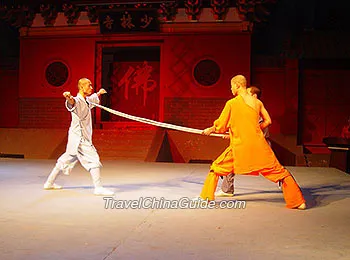
Over the centuries of development in People's republic of china, Kung Fu has become a large system containing various schools or sects. It is recorded that there are over 300 distinct types of boxing existing around the state. The styles in northern and southern China are quite unlike. Therefore it is hard to be simply classified
Some of the schools are classified by geographical locations, for example, the Southern Fist (Nanquan) prevailing in south Cathay, and Shaolin School based at Shaolin Temple in Henan Province. Some are named afterward the creator and primary, like the Chen Fashion Tai Chi and Yang Fashion Tai Chi. Some are identified past dissimilar training methods, such as the Internal Boxing Arts (Neijiaquan) that concentrate on the manipulation of the inner breath and circulation of the body, and the External Battle Arts (Waijiaquan) concentrating on improving the muscles and the limbs.
The near outstanding and influential schools are listed equally follows:
1. Shaolin Martial Arts: Originated in the Shaolin Temple in Henan, this is considered the premier mode in China and is widely spread all over the globe. Both of its physical exercise and mental preparation are based upon Buddhist philosophy. The Shaolin Boxing, Southern Fist (Nanquan), Northern Legs (Beitui) and Wing Chun are the representatives of this schoolhouse.
2. Wudang Martial Arts: This sect has almost the same fame as the Shaolin. Based at the Mt. Wudang in Hubei Province, it is developed under the guidance of Taoist theories. T'ai Chi Ch'uan, Form / Intention Boxing (Xingyiquan), 8-Diagram Palm (Baguazhang) are essentials of Wudang.
3. Emei Martial Arts: Taking Mt. Emei in Sichuan Province as its military camp, this sect is moderate and blends the merits of Shaolin and Wudang. Many sub-branches derive under this sect, including Qingcheng, Tiefo, Qingniu, Dianyi, Huanglin, etc.
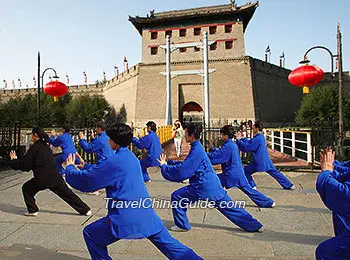 |
| Tai Chi Quan Performance |
4. Tai Chi: This is a comparatively irksome and elegant style originated from the combination of Taoism, dialectic ideology, traditional medicine and physical exercise. It features attack by accumulating the force, conquering the rigidity with the flexility, and beating action by inaction.
five. Class / Intention Boxing (Xingyiquan): It is a representative of Internal Boxing Arts characterized past its straightforward fist and quick set on which are well suitable for fighting confronting the enemy. Its battle routines include 5 Elements Boxing, Twelve Animals Boxing so on.
half-dozen. Eight-Diagram Palm (Baguazhang): Created by the chief Dong Haichuan, the Eight-Diagram Palm features continuous changes in palm styles and steady steps in circle. Many sub-sects derive from this school.
seven. Southern Fist (Nanquan): This traditional school prevailed over 400 years in south China. Centered in Guangdong and Fujian Provinces, information technology features short and tight movements, diverse skills, steady steps and vigorous attacks. The grand principal Wong Fei-hung is proficient at the Southern Fist.
8. Qigong: Information technology is not only a school of martial arts only also a concrete and mental exercise method, which is beneficial to health and torso-building. There are mainly two types - Dynamic Qigong practiced by specific body movements, and Static Qigong practiced by adjusting the jiff and listen.
Learn Kung Fu
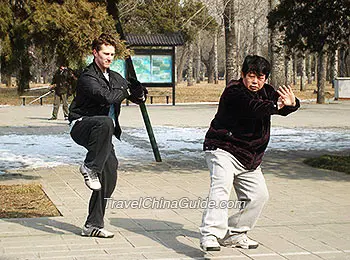 |
| Learn Tai Chi Quan |
In the recent years, learning Chinese martial arts has been more and more popular amid people of different ages and nationalities. Therefore, many Kungfu training centers or clubs have been established. A potent will and persistence is the precondition for learning. 1 should follow a principal or join a training school to learn systematically. The basic skills of legs, waist, shoulders and stance training need to be practiced daily. Employing the solid foundation of the basic skills, one can choose from the various sects to larn specific routines of battle, kicking and weapon skills, to better the combat ability.
Kung Fu Masters
 Bruce Lee: (Nov. 27, 1940 - Jul. 20, 1973) Equally the founder of Jeet Kune Do, he is a great main who was a brilliant Kungfu picture star in 1970s and fabricated the Chinese Kung Fu well-known throughout the globe.
Yip Man: (October.1, 1893 - Dec.2 1972) He was a great martial artist contributing a lot in the development of Wing Chun. He had many students who later became masters in their own right, including Bruce Lee.
Huo Yuanjia: (Jan. 18, 1868 - Aug.9, 1910) As a co-founder of the Mentum Woo Martial Arts Schoolhouse, Huo was considered a patriotic and heroic master for defeating many strange fighters at his fourth dimension.
Wong Fei-hung: (Jul.9, 1847 - 25 Mar.25, 1924) He was a master in Hung Gar Battle, a style of Southern Fist Schoolhouse.
Zhang Sanfeng: (1247 - 1458) He is a legendary martial arts master and ancestor of Wudang School.
* There are many other masters, including Chen Wangting - the founder of Chen Fashion Tai Chi, Yang Luchan - the founder of Yang Style Tai Chi, Dong Haichuan - the creator of Eight-Diagram Palm, Liang Ting - the initiator of International Fly Tsun Association, etc.
Attractions Related to Kung Fu
Shaolin Temple, Henan: The once birthplace of the famous Shaolin Schoolhouse is now a flourishing temple attracting numerous Buddhist disciples and visitors. Yous can appreciate the historical relics while watching the splendid Kungfu shows.
Emei Mount, Sichuan: Birthplace of Emei Schoolhouse
Mt. Wudang, Hubei: Birthplace of Wudang School
Mainland china Martial Arts Museum in Shanghai
Places in Beijing to Lookout man Kung Fu Shows
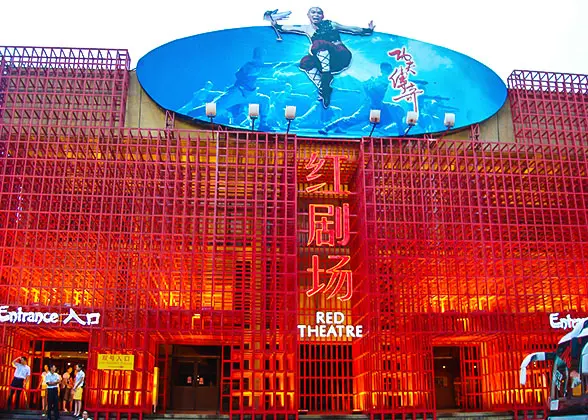 |
| Cherry Theater, Beijing |
Beijing Carmine Theater
The about famous evidence (Kung Fu Legend) in this theater tells the growth of a niggling monk, and is rather entertaining.
Address: Workers' Art Palace, No. 44, Xingfu Street, Dongchen District
How to get there: Take Autobus 6, eight, 34, 35, 36, 41, 60, 116, 707, 957, 958 and go off at Beijing Tiyuguan (Beijing Stadium) Station.
Kung Fu Kids
Accost: 3F, SOLANA Vivid Town, west gate of Chaoyang Park, Chaoyang District
How to go in that location: take Bus 419, 852, 985 at Chaoyang Gongyuan Ximen Station.
Laoshe Teahouse
In add-on to opera, acrobatics, folk music and tea ceremony performances, you can as well picket Kungfu shows here.
Accost: Building 3, Zhengyang Market, Qianmen West Street, Xicheng District
How to go there: Have double-decker 8, 17, 22, 43, 44, 48, 826, etc and get off at Qianmen Station; Take Subway Line 2 and go at Qianmen Station and out from Exit C.
Kungfu Movies
Since 1970s, such movies accept been more and more popular. People can marvel at the amuse of martial arts from the stunning moving picture works like the Fists of Fury, Style of the Dragon, Shaolin Temple, Ip Man, Crouching Tiger and Hidden Dragon, Hero, etc. The famous picture stars include Bruce Lee - the 'King of Martial Arts', Jet Li who has played well many figures in a number of blockbusters, and Jackie Chan noted for his outstanding skills in the film industry at abode and away.
Martial Arts Novels
This popular genre of Chinese fiction is also well known equally Wuxia, which features the adventures of martial artists. Notable writers like Jin Yong, Liang Yusheng and Gu Long accept many popular Wuxia works, which have been adapted for movies or TV series and passionately followed by fans.
- Last modified on Mar. 22, 2022 -
Source: https://www.travelchinaguide.com/intro/martial_arts/
0 Response to "How to Describe a Martial Art Student in Japanese"
Postar um comentário