Finding How Many Units of Something Is if You Know How Much Total Cost Is
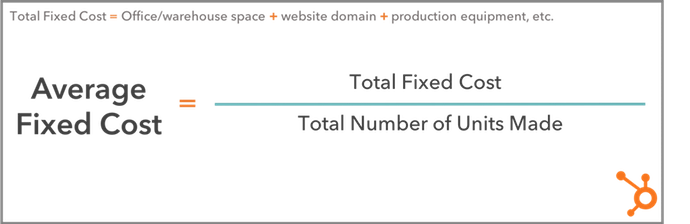
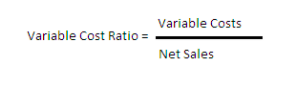
There'south a frustrating truth that every business concern deals with early into its growth: More than money, more bug. It seems counterintuitive — if sales and acquirement are upward, isn't that a practiced thing? How are bigger profits a potential trouble? Put simply, information technology all comes down to the fact that the more you sell, the more coin you need to spend. This includes marketing and sales campaigns to reach more than customers, the production costs of more appurtenances, and the time and money required for new product development. Known as variable cost, this sales/spend ratio is something every business concern owner should understand, but online advice listicles and action plans frequently presume readers accept an intrinsic cognition of this concept rather than providing a working definition. In this piece, we'll clear upwardly variable price confusion: Here'southward what y'all need to know about variable costs, how to summate them, and why they matter. Variable costs are the sum of all labor and materials required to produce a unit of measurement of your product. Your total variable cost is equal to the variable price per unit, multiplied by the number of units produced. Your average variable toll is equal to your total variable cost, divided by the number of units produced. Let's examine each of these components in more detail. The variable cost per unit is the amount of labor, materials, and other resource required to produce your production. For example, if your visitor sells sets of kitchen knives for $300 but each set requires $200 to create, test, package, and market, your variable cost per unit is $200. The number of units produced is exactly what you lot might expect — it's the total number of items produced by your visitor. So in our knife example in a higher place,if you lot've made and sold 100 pocketknife sets your total number of units produced is 100, each of which carries a $200 variable price and a $100 potential profit. To calculate variable costs, multiply what it costs to brand 1 unit of measurement of your product by the total number of products you've created. This formula looks like this: Total Variable Costs = Cost Per Unit x Total Number of Units. Variable costs earn the proper noun considering they can increment and decrease as you make more or less of your production. The more units y'all sell, the more coin you'll make, but some of this coin will need to pay for the production of more units. So, you'll demand to produce more units to actually turn a profit. And, because each unit requires a sure amount of resources, a higher number of units will heighten the variable costs needed to produce them. Variable costs aren't a "problem," though — they're more of a necessary evil. They play a office in several bookkeeping tasks, and both your full variable cost and average variable cost are calculated separately. Your total variable price is the sum of all variable costs associated with each individual product y'all've developed. Calculate total variable cost past multiplying the cost to make one unit of your production by the number of products yous've developed. For example, if information technology costs $lx to brand one unit of your product and you've made 20 units, your full variable price is $60 x twenty, or $1,200. Your average variable cost uses your total variable cost to determine how much, on average, it costs to produce one unit of your product. Y'all tin can calculate it with the formula below. If the average variable price of one unit is found using your total variable cost, don't you already know how much one unit of your product costs to develop? Can't you work backward, and just split your total variable cost by the number of units yous take? Not necessarily. While total variable cost shows how much y'all're paying to develop every unit of measurement of your production, you might also take to account for products that accept unlike variable costs per unit. That'southward where average variable toll comes in. For instance, if yous accept 10 units of Production A at a variable toll of $60/unit, and xv units of Product B at a variable cost of $xxx/unit, you accept two different variable costs — $60 and $thirty. Your average variable cost crunches these two variable costs down to one manageable figure. In the above instance, yous can discover your average variable cost by adding the total variable price of Product A ($sixty ten x units, or $600) and the total variable cost of Production B ($30 x 15 units, or $450), then dividing this sum by the total number of units produced (10 + 15, or 25). Your boilerplate variable toll is ($600 + $450) ÷ 25, or $42 per unit. The opposite of variable cost? Stock-still cost. Fixed costs are costs that don't modify in response to the number of products yous're producing. Some common fixed costs include renting or leasing a building, utility bills, website hosting, business concern loan repayments, and holding taxes. Worth noting? These costs aren't static — significant, your rent may increase yr over yr. Instead, they remain fixed but in reference to product production. To summate the average stock-still cost, use this formula: Both variable and stock-still costs are essential to getting a consummate picture of how much it costs to produce an item — and how much turn a profit remains afterwards each sale. The variable cost ratio allows businesses to pinpoint the relationship between variable costs and cyberspace sales. Calculating this ratio helps them account for both the increasing revenue likewise every bit increasing production costs, so that the company tin can keep to grow at a steady step. To calculate variable cost ratio, use this formula: Let'south put it into practice. If you're selling an detail for $200 (Net Sales) just information technology costs $20 to produce (Variable Costs), you dissever $20 by $200 to get 0.i. Multiply by 100 and your variable cost ratio is 10%. This means that for every auction of an particular you lot're getting a 90% return with 10% going toward variable costs. Combining variable and fixed costs, meanwhile, can help you lot calculate your break-even point — the indicate at which producing and selling goods is zeroed out by the combination of variable and fixed costs. Consider our example above over again. If your variable costs are $20 on a $200 item and your fixed costs business relationship for $100, your total costs now account for lx% of the item'south sale value, leaving you with 40%. Put simply? The higher your total cost ratio, the lower your potential profit. If this number becomes negative, you've passed the break-even point and will offset losing money on every sale. And then, what'southward considered a variable price to the business organization? Some of the virtually mutual variable costs include concrete materials, production equipment, sales commissions, staff wages, credit card fees, online payment partners, and packaging/aircraft costs. Let's examine each in more particular. These tin include parts, cloth, and even food ingredients required to make your last product. If you automate certain parts of your production'southward development, you might need to invest in more automation equipment or software as your product line gets bigger. The more products your company sells, the more than you might pay in commission to your salespeople as they win customers. The more products y'all create, the more employees yous might need, which means a bigger payroll, likewise. Businesses that receive credit card payments from their customers will incur higher transaction fees every bit they deliver more services. Apps like PayPal typically accuse businesses per transaction so customers tin can check out purchases through the app. The more orders you receive, the more you'll pay to the app. You might pay to package and transport your product by the unit of measurement, and therefore more or fewer shipped units will crusade these costs to vary. While variable costs, full variable costs, average variable costs, and the variable cost ratio oftentimes seem complicated on the surface, these terms are just means to represent the changing nature of costs to produce new items as your concern grows. By understanding the nature of these costs and how they touch on your current and projected acquirement, it'southward possible to amend prepare for evolving market forces and reduce the bear upon of variable costs on your bottom line. 
What is a variable price?
Variable Cost Per Unit of measurement
Number of Units Produced
Variable Cost Formula
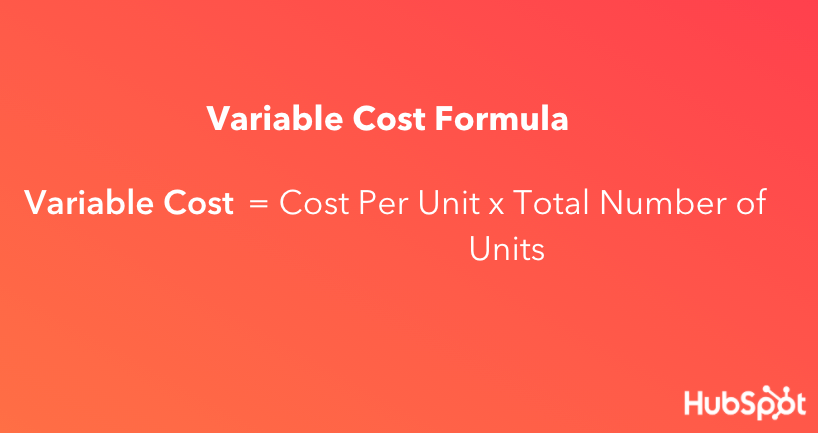
Total Variable Cost

Average Variable Cost
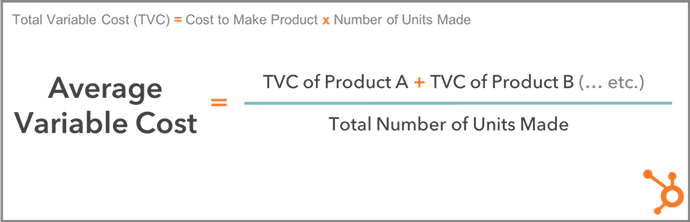
Total Variable Cost vs. Average Variable Cost
Variable vs. Fixed Toll
What is the variable price ratio?
Variable Cost Examples
Physical Materials
Production Equipment
Sales Commissions
Staff Wages
Credit Card Fees
Online Payment Partners
Packaging and Shipping Costs
Wait the Unexpected


Originally published Jun 24, 2021 8:00:00 AM, updated June 24 2021
Source: https://blog.hubspot.com/marketing/variable-cost
0 Response to "Finding How Many Units of Something Is if You Know How Much Total Cost Is"
Postar um comentário